


About Us
Visualize the invisible world with a giant microscope

Questions everyone has are answered here
Frequently Asked Questions
General questions about SPring-8
This is a facility where experiments and research are conducted using Synchrotron Radiation generated from an accelerated high-energy electron beam. Research fields and results are as follows.
・Applications in Material Science: Atomic and electronic structure of advanced materials, material properties under extreme conditions, creation of new materials, material modification, etc.
・Applications in Life Science and Medicine: Structural analysis of biological materials such as proteins (→ research on life mechanisms, pharmaceutical development, etc.), and high-resolution imaging of biological samples using refraction contrast imaging, etc.
・Applications in Environmental Science: Analysis of environmental purification catalysts, analysis of trace environmental pollutant elements in biological samples, etc.
・Applications in Earth Science and Space Science: Structural and state analysis of deep-earth materials, structural analysis of meteorites and cosmic dust, etc.
・Industrial Use: Utilized for material evaluation in industry and structural analysis of proteins
This is a shared facility under the jurisdiction of the national government (Ministry of Education, Culture, Sports, Science and Technology).
RIKEN, the facility owner, operates the facility, and the Japan Synchrotron Radiation Research Institute (JASRI), a Registered Institution for Facilities Use Promotion, performs the user selection and user support tasks (usage promotion services).
SPring-8 is the general term for the entire facility including the Linear Accelerator, Synchrotron, Storage Ring, beamlines, and their auxiliary facilities, but in a narrow sense it sometimes refers only to the Storage Ring and beamlines.
As of October 2019, approximately 440 staff members work at SPring-8 and SACLA combined.
In addition, within the SPring-8 site, staff from other facilities and institutions on site (NewSUBARU synchrotron radiation facility, Hyogo Prefectural Synchrotron Radiation Nanotechnology Laboratory, Japan Atomic Energy Agency, National Institutes for Quantum Science and Technology) and staff from Contract Beamlines also work. During periods when each facility is operating, approximately 250 users conduct experiments daily.
Researchers from domestic public and private universities, research institutions, and private companies, as well as researchers from overseas research institutes and universities.
We call for research proposals twice a year, and you must apply. For details, Please refer to here
After experiments are completed, if research results are made public, there is no usage fee. If results are not made public, a usage fee of 60,000 yen per hour (480,000 yen / 8 hours) is required. For details, see herePlease refer to
SPring-8 (pronounced Spring-Eight) is an English acronym meaning "Super Photon (photon = particle of light) Ring (ring = circular accelerator = storage ring) 8 billion electron volts (= 8 giga electron volts)" Super Photon ring 8GeV. The official name of the facility is "Large Synchrotron Radiation Facility," and it is written as "Large Synchrotron Radiation Facility (SPring-8)."
The initial construction cost was approximately 110 billion yen. The land was provided by Hyogo Prefecture.
The budgets for facility operation and maintenance of SPring-8 and SACLA in fiscal year 2018 were approximately 8.5 billion yen and 5.6 billion yen respectively, and the budget for user selection and user support was approximately 1.4 billion yen.
The budget for user selection and user support is used to promote the use of both SPring-8 and SACLA.
The SPring-8 Operation Schedule consists of continuous operation periods of approximately 2 to 3 weeks. Except for shutdowns between cycles and long-term inspection and adjustment periods in summer and winter, experiments are basically conducted with 24-hour continuous operation.
SPring-8 is an experimental facility for analysis and evaluation, not a manufacturing facility, so it does not manufacture products.
For example, at the Drug Discovery Industrial Beamline, structural analysis of proteins necessary for developing pharmaceuticals is performed, but the pharmaceuticals themselves are not manufactured there.
The Particle Beam Medical Center is an independent institution and does not use light from SPring-8. The Particle Beam Medical Center uses particle beams (proton beams, carbon beams) rather than light to treat cancer and other diseases.
Under the current SPring-8 usage system, it would be difficult to authenticate personal collections. It may become possible in the future if a contract analysis service system is established.
Both LHC and SPring-8 are accelerator *1facilities, but the particles being accelerated and the purpose of facility use differ.
SPring-8 is a synchrotron radiation facility that uses synchrotron radiation (hereinafter referred to as "synchrotron radiation") generated by bending accelerated electrons with magnets.
Using this synchrotron radiation, the structure and function of materials and the composition of substances can be observed, measured, and analyzed at the atomic level (in the nano world), and it is widely used for research and development in academic and industrial fields.
On the other hand, the LHC (Large Hadron Collider) is a facility where protons (a type of hadron) are accelerated and made to collide head-on, allowing for the investigation of the reactions (phenomena) that occur at that time.
This facility conducts research on elementary particles (the smallest indivisible units of matter, such as quarks, electrons, neutrinos, and photons), including the discovery of the "Higgs boson" that recently became a topic of interest.
However, SPring-8 also has beamlines for the purpose of studying elementary particles. At the Laser-Electron Photon beamline established by Osaka University, research primarily on quarks *2is being conducted.
*1 A device that accelerates and controls charged particles such as electrons and protons using electric and magnetic fields to generate high-speed particles (with high kinetic energy).
At SPring-8, electrons are accelerated to 8 billion electron volts (equivalent to 99.9999998% of the speed of light) and guided into a device with a circumference of approximately 1.5 km called a storage ring to generate synchrotron radiation.
On the other hand, the LHC is a massive device installed 100 m underground with a circumference of 27 km spanning the border between Switzerland and France, in order to accelerate protons (which are about 1,800 times heavier than electrons) to 7 trillion electron volts (equivalent to 99.9999991% of the speed of light).
Huge detectors are installed at four locations along this circumference to conduct high-energy physics experiments, such as observing elementary particle reactions.
*2 Physical Review Letters Physical Review LettersThe "Discovery of the Pentaquark" published in the July 2003 issue of the American Physical Society's journal is a notable achievement of research using this beamline.
While protons and neutrons are made of three quarks, this was the first time in the world that a particle composed of four or more quarks, which had been theoretically predicted, was experimentally demonstrated.
Questions regarding tours of SPring-8
Site Tour Pageprovides information regarding site tours. There is a course where you can view part of the Experimental Hall through glass. Please check the details on that page and apply via the tour application form.
It opened on April 16, 2000.
In March 2004, SOR-RING was put on display at the Public Relations Center.
About SOR-RING
SOR-RING was the world's first electron storage ring dedicated to synchrotron radiation (completed in 1974 and classified as a second-generation synchrotron radiation facility).
It was established within the Institute for Nuclear Study (at the time) of the University of Tokyo in Tanashi City, Tokyo (now Nishitokyo City) as the Synchrotron Radiation Laboratory of the Institute for Solid State Physics, University of Tokyo. It contributed greatly to the development of synchrotron radiation science worldwide but ended its role in 1997.
In the same year, the third-generation Large Synchrotron Radiation Facility (SPring-8) was completed and began operation. Thus, 1997 can be called the year of generational change for synchrotron radiation facilities in Japan.
Later, SOR-RING was relocated to SPring-8 in its original form and put on display in a corner of the Public Relations Center.

SOR-RING on display at the Public Relations Center
Questions about synchrotron radiation
Physically, radiation includes all electromagnetic waves and particle beams such as X-rays and alpha rays. However, "radiation" as defined by law refers to ionizing radiation (those with direct or indirect ionizing effects) such as X-rays, alpha rays, beta rays, gamma rays, neutron beams, electron beams, and heavy ion beams, and does not include radio waves, infrared, visible light, or ultraviolet.
Synchrotron radiation refers to electromagnetic waves (synchrotron radiation) generated when charged particles such as high-energy electrons are bent by a magnetic field. This includes infrared, visible light, ultraviolet, and X-rays. In other words, it is the name for electromagnetic waves generated by this principle of synchrotron radiation.
The term radioactivity refers to (1) the property of emitting radiation such as alpha, beta, and gamma rays, (2) the intensity of such properties, and (3) substances possessing such properties (radioactive substances); therefore, it is completely unrelated to synchrotron radiation.
Both are highly directional light (electromagnetic waves).
Synchrotron radiation is white light (electromagnetic waves containing all wavelengths) or quasi-monochromatic light. By combining it with a spectrometer, it can be used as a wavelength-tunable, high-brilliance monochromatic light source over a wide range from infrared to X-rays.
Lasers are monochromatic, coherent beams of light with high peak power, allowing monochromatic light to be extracted without using a spectrometer. However, the wavelength range is limited to far-infrared to vacuum ultraviolet, and lasers in the X-ray range are currently in the development stage.
Only the visible light portion of light can be seen by the eye. Since synchrotron radiation contains a mixture of all colors of light (visible light), it appears as white light.
In beamlines used for X-rays, synchrotron radiation cannot be seen directly because filters that block visible light or windows made of beryllium (vacuum partitions) are placed along the path.
However, in soft X-ray or infrared beamlines that do not have filters or windows, the direct synchrotron radiation (the visible light portion) can be seen.
Synchrotron radiation is emitted from the bending magnet spreading out in a fan shape, like water droplets flying off the edge of a spinning umbrella.
The horizontal spread of synchrotron radiation emitted from a single bending magnet is determined by the length of that bending magnet (in the case of the SPring-8 bending magnet, the divergence angle is 4.04 degrees).
The vertical spread is determined by the energy of the electron beam running through the storage ring, the strength of the magnetic field of the bending magnet, and the energy of the emitted synchrotron radiation (in the case of the SPring-8 bending magnet, the divergence angle is 0.0036 degrees or 62.5 microradians for X-rays with an energy of 28.9 keV).

Bending magnet on display in the exhibition room
Synchrotron radiation is white light (electromagnetic waves containing all wavelengths) or quasi-monochromatic light, but the phases are not aligned.
Light is a wave (electromagnetic wave), but it can also exhibit particle-like properties depending on how it interacts with matter. Generally, longer wavelengths exhibit wave properties, while shorter wavelengths exhibit strong particle-like properties.
Questions about safety
Synchrotron radiation is radiation (infrared, visible light, ultraviolet, X-rays) generated by a specific method (*). Therefore, excessive exposure will cause effects similar to other types of radiation (burns from infrared, visual impairment from visible light, skin damage from ultraviolet or X-rays, etc.).
(*) In a broad sense, radiation includes all electromagnetic waves and particle beams, but in a narrow sense, radiation refers to ionizing radiation (radiation with ionizing effects) such as X-rays, alpha rays, beta rays, gamma rays, neutron beams, electron beams, heavy ion beams, and cosmic rays.
The handling of radiation is strictly regulated by law.
At SPring-8, radiation shielding is designed with a safety margin. Additionally, a dedicated radiation management team is stationed in the Safety Office to strictly manage radiation safety so that levels remain well below legal limits.
It is known that strong static magnetic fields can cause malfunctions in individuals wearing cardiac pacemakers or surgical clips.
It is also known that strong AC magnetic fields can cause burns. However, the details of how magnetic fields affect health are not yet well understood.
Earth is protected from cosmic rays by its geomagnetism, and the atmosphere has a shielding capacity equivalent to a 10 m thick wall of water. Therefore, the intensity of cosmic rays reaching the ground is very weak and has no impact on health.
Organisms on Earth have continued to evolve while being exposed to weak cosmic rays since the time of the first single-celled organisms. If there were organisms that could not withstand even weak radiation, they would not have survived the evolutionary process.
Furthermore, the intensity of cosmic rays is much stronger outside the atmosphere; inside a space shuttle, one is exposed to more cosmic rays in a single day than in a year on the ground.
Physical questions regarding electrons and accelerators
Electrons are one of the fundamental particles that make up an atom; they are negatively charged particles that orbit the atomic nucleus. Electrons are also what ran inside the cathode ray tubes of televisions common before LCD TVs to make the screen glow. Furthermore, electric current is generated by the movement of electrons through metal.
The color of a substance (provided it does not emit light itself) is determined by which wavelengths of visible light it reflects or absorbs. The size of an electron is extremely small, and since it is fundamentally impossible to see an electron itself directly with visible light, electrons have no color. However, it is possible to see the light generated when electrons hit a substance such as a fluorescent screen (though this is light emitted by the fluorescent substance, not by the electrons).
A unit of energy. The amount of increase in the kinetic energy of an electron when it moves between electrodes with a voltage of 1 volt (= 1.602 × 10⁻¹⁹-19joules) is called one electron volt (1 eV).
Thermionic electrons are generated by raising the temperature of a substance in a vacuum. These are accelerated using electrostatic or high-frequency electric fields, and their orbits are bent or focused like a lens using magnetic fields.
Microwaves (ultra-high frequency) refer to electromagnetic waves with wavelengths from approximately 1 mm to 1 m. Microwaves are divided into submillimeter waves, millimeter waves (EHF), centimeter waves (SHF), and decimeter waves (UHF) in order of decreasing wavelength. Household microwave ovens generate microwaves with a wavelength of about 10 cm to vibrate water molecules in food, heating the food through frictional heat.
The orbits of the electrons circulating in the storage ring are bent by magnets to generate synchrotron radiation. The electron beam is used to generate synchrotron radiation.
Electrons lose kinetic energy by emitting synchrotron radiation. Therefore, when the RF acceleration system is turned off, the orbital radius of the electron beam decreases, and the electrons collide with the vacuum chamber walls or metal plates called dampers. When electrons hit matter, they lose their kinetic energy and stop. That kinetic energy is converted into heat.
The cross-sectional shape of the electron beam varies by location, but on average, it is elliptical. The cross-section of the electron path in the vacuum chamber was designed to be similar to the cross-sectional shape of the electron beam, resulting in an elliptical shape.
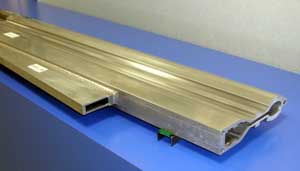
Vacuum chamber for the straight section on display in the exhibition room
The frequency of electron injection varies depending on operating conditions, but at SPring-8, it is basically once a day (once every 24 hours) or twice a day (once every 12 hours). The number of electron injections per session is several hundred at intervals of approximately one second. However, top-up operation began in June 2004, resulting in approximately 1 to 3 injections every 1 or 5 minutes.
Technical questions regarding accelerators and synchrotron radiation generators
SPring-8 uses barium-impregnated tungsten.
The material is aluminum alloy, manufactured using the extrusion method. Some parts are made of stainless steel.
Aluminum alloy is suitable as a material for vacuum chambers because (a) it is a non-magnetic metal, (b) it has good vacuum characteristics (can maintain a high degree of vacuum), (c) it has good activation characteristics (it is difficult to form radioactive elements that emit radiation over long periods even if atoms are activated by high-energy electrons), and (d) it has good processing characteristics, allowing for inexpensive and high-precision manufacturing.
On the other hand, stainless steel can also be used as a material for vacuum chambers. However, since stainless steel is difficult to process using the extrusion method, the manufacturing methods and costs differ from those of aluminum alloys.
Regarding the accelerators, most of the technology is domestically produced.
The maximum is approximately 14,000 gauss at the magnet surface, but it is several thousand gauss where the electron beam passes. The magnetic flux density varies for each undulator and depends on the magnet gap.
Powerful magnets commonly seen in the home include those used in magnetic health necklaces. These magnets have a magnetic field of approximately 800 to 1,800 gauss, which is about 1/10th that of an undulator magnet. Magnets used on refrigerator walls as clip substitutes are only a fraction of that strength.
These are anisotropic sintered magnets composed primarily of neodymium, iron, and boron, and are currently the world's strongest permanent magnets. These magnets not only have strong magnetic force but also do not lose their properties even when exposed to high-temperature environments.
SPring-8 uses many in-vacuum undulators (a type of undulator where magnets are placed inside the ultra-high vacuum where the electron beam circulates).
Generally, gas emitted from objects placed in a vacuum lowers the degree of vacuum. To achieve an ultra-high vacuum, it is necessary to remove the gas by heating the objects beforehand. With conventional magnets, heating degrades the magnetic properties, making it difficult to create an in-vacuum undulator; however, this was realized by using neodymium-iron-boron magnets.
This magnet was developed in Japan. Many Japanese names appear in the history of the discovery of powerful magnets. Japan is at the global forefront of magnet research, and naturally, research into magnetism (the magnetic properties of matter) continues day and night at SPring-8.
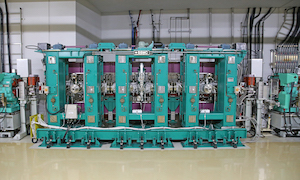
Undulator
Since the energy of the electron beam in the storage ring is constant, the current supplied to the bending magnets is DC (direct current). A direct current of 1,200 amperes creates a magnetic field of 7,000 gauss.
Of the total storage ring operation time in FY2016 (4,941 hours), the planned user time totaled 4,152 hours. In contrast, the time users were unable to utilize the facility due to equipment failure (downtime) totaled 23 hours. After subtracting other factors such as operation mode switching time, the actual utilization time was 4,125 hours.
Therefore, downtime relative to total user time was slightly less than 0.6%, and overall stable operation was maintained. Causes of the slightly less than 0.6% downtime included equipment failures such as discharge in high-power RF system equipment and leakage in cooling hoses for electromagnets, as well as environmental factors such as earthquakes and momentary voltage drops in the power supply.
Questions regarding synchrotron radiation use and research results
The first measurement through the Wakayama District Public Prosecutors Office was performed at the High Energy Inelastic Scattering Beamline BL08W. The second measurement requested by the Wakayama District Court was performed using BL08W and the Magnetic Materials Beamline (then called the Bioanalysis Beamline) BL39XU.
All measurements were performed using a method called X-ray fluorescence analysis using synchrotron radiation. When X-rays are irradiated onto a substance, element-specific X-rays are generated, so by measuring the type (energy or wavelength) and amount of those X-rays, the types and amounts of elements contained in the substance can be determined (X-ray fluorescence analysis). Moreover, a characteristic of this method is its ability to detect trace elements.
In the Wakayama Curry-Poisoning Case, arsenious acid was identified and distinguished by comparing the amounts of specific impurity elements contained in the arsenious acid. This method can also be used to identify the origin of materials.
X-rays at SPring-8 enable analysis of heavy elements that was previously impossible, and this characteristic made it possible to identify and distinguish arsenious acid. This is because it was necessary to detect heavy element impurities such as antimony (Sb) and bismuth (Bi).
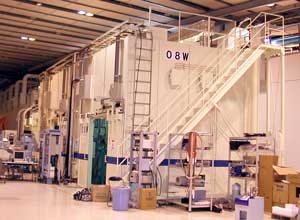
High Energy Inelastic Scattering Beamline
BL08W Experimental Hutch
Fundamentally, this is an experimental facility for observing materials at the atomic and electron level, so it is useful for basic research, but there are many examples where it has been useful in practical life.
By identifying the cause of degradation in the charging characteristics of lithium batteries, this contributed to extending their lifespan.
By directly observing the atomic spacing of semiconductor elements, there are examples where the oscillation efficiency of optical semiconductor elements was improved and production yields were enhanced.
By confirming the function of non-degrading automotive exhaust gas purification catalysts at the atomic level, this contributed to practical application (for details, see " "Industrial Applications at SPring-8"" for details).
In addition, protein structural analysis is expected to lead to the development of new pharmaceuticals.
At SPring-8, X-ray Fluorescence Analysis has been used to analyze archaeological artifacts such as ancient pottery, old ceramics (fragments), Buddhist statues, ironware, bronze mirrors, and more.
When X-rays are irradiated onto a material, element-specific X-rays are generated from the material. By measuring the type (energy or wavelength) and amount of those X-rays, you can determine the types and amounts of elements contained in the material (X-ray Fluorescence Analysis). Because this method can measure the object (sample) non-destructively, it can be used to analyze valuable artifacts that cannot be destroyed or chemically treated.
From the proportions of trace elements contained in these archaeological artifacts, it is possible to estimate their origin and transport routes. It is also used to estimate manufacturing methods.
Such research also plays a role in introducing scientific research methods into fields that in Japan have been treated only as cultural studies.
Because the SPring-8 X-ray beam has high brilliance and can be tightly focused, measurements are possible even with small samples.
As protein samples, crystals typically about 50–100 µm on a side are used. There are also examples of structural analysis performed with crystals of about 3 µm.
Intracellularly synthesized polyhedral crystals used for high-resolution analysis at 理研ターゲットタンパクビームラインBL32XU
(Size is approximately 3 µm)

Structural Biology I beamlineBL41XUExperimental Equipment for Protein Crystal Structure Analysis at
RIKEN is involved in the Human Genome Project (a project to determine the base sequence of human genes), but SPring-8 is not participating.
However, SPring-8 does participate in the structural genomics project (a project to examine the 3D structures of proteins produced by genes). Currently, there are three Public Beamlines for protein structural analysis, and 30% of the beamtime on these beamlines is used for the structural genomics project.
In addition, RIKEN has two beamlines dedicated to structural genomics research. Researchers nationwide use these beamlines to conduct measurements 24 hours a day.
Protein structural analysis begins with preparing protein crystals. X-rays are irradiated onto the crystals, and structural analysis is performed using the phenomenon of X-ray diffraction.
Protein crystals are not hard crystals like diamonds or salt; they contain large amounts of water molecules and are as soft as tofu.
When X-rays are irradiated, water molecules are ionized, and the ions react with surrounding water molecules to generate Hydroxyl Radicals. These Hydroxyl Radicals break protein bonds. Therefore, continued X-ray irradiation gradually destroys protein crystals (radiation damage).
However, because protein crystals contain an enormous number of proteins—on the order of tens of billions—it takes some time before crystal destruction affects the measurement data. Within this time, the X-ray diffraction data required for structural analysis are collected.
In other words, protein structural analysis is a race against crystal destruction. Naturally, measures are needed to slow crystal destruction. Protein crystals are frozen, and measurements are taken while blowing low-temperature nitrogen gas onto the crystal.
Questions about SPring-8 facilities
There is an extra-high voltage switching station in front of the SPring-8 main gate, receiving power via two 77,000 V lines from the Kansai Electric Power Techno-Polis Substation.
From the switching station, power is distributed at 77,000 V to the on-site Extra-High Voltage Substation No. 1 (Storage Ring), Extra-High Voltage Substation No. 2 (beam injection system / Linear Accelerator / Synchrotron), and Extra-High Voltage Substation No. 3 (Accelerator and Beamline R Facility / Structural Biology Experimental Facility / NewSUBARU and the X-ray Free Electron Laser Facility, etc.). It is then stepped down from 77,000 V to 6,600 V at each extra-high voltage substation, after which it is supplied to high-voltage substations installed for each demand location.
The electricity actually used is stepped down within the high-voltage substation from 6,600 V to 400 V (power), 200 V (lighting, etc.), and 100 V (outlets), and then sent to each demand location.

Extra-High Voltage Substation No. 3
SPring-8 covers 141 hectares (1,410,000 m²). That is about 36 times the size of Koshien Stadium, about 30 times the size of Tokyo Dome, and about 2.8 times the size of the Tokyo Disneyland theme park area.

Overview (aerial photo)
Frequently Asked Questions from Users
At SPring-8, inspection and adjustment periods of about 1.5–2 months in summer, about 1 month in winter, and about 1 month at the end of the fiscal year are set.
These periods are set for maintaining the SPring-8 facility, inspecting power-receiving equipment as required by law, and improving the accelerator system and beamline to enhance beam performance.
The main reason a long periodic inspection period is set in summer is that, from the standpoint of economic rationality, it is judged most effective to reduce operations as much as possible from July to September, when the unit electricity rate is higher.


