What is SPring-8?
SPring-8, located at The Harima Science Garden City in Hyogo produces the world’s highest performance synchrotron radiation at its large synchrotron radiation facility. SPring-8 uses synchrotron radiation for nanotechnology, biotechnology, and even industrial use through its wide range of research. The name SPring-8 derives from the “Super Photon Ring-8 GeV” (8 billion electron volts). SPring-8 is a joint-operated facility open to researchers from industry, science and government within Japan as well as overseas. Since 1997, synchrotron radiation has been provided to universities, public research institutes and companies. Any user whose application is accepted may use the facility. SPring-8 is operated by RIKEN, with it’s user selection and user support (user promotion) managed by The Japan Synchrotron Radiation Research Institute.
The right experimental equipment
tailored to your specific research objectives
Synchrotron Radiation of SPring-8
Synchrotron radiation is emitted from electrons when
their direction of motion is influenced to bend by magnetic fields (magnets).
The synchrotron radiation created by SPring-8
uses high electron energy and contains X-rays with shorter wavelengths,
resulting in stronger transmission.
Due to the narrow focused, high brightness beam,
it is possible to illuminate areas
smaller than the micro level.
Mechanisms of Synchrotron Radiation with SPring-8
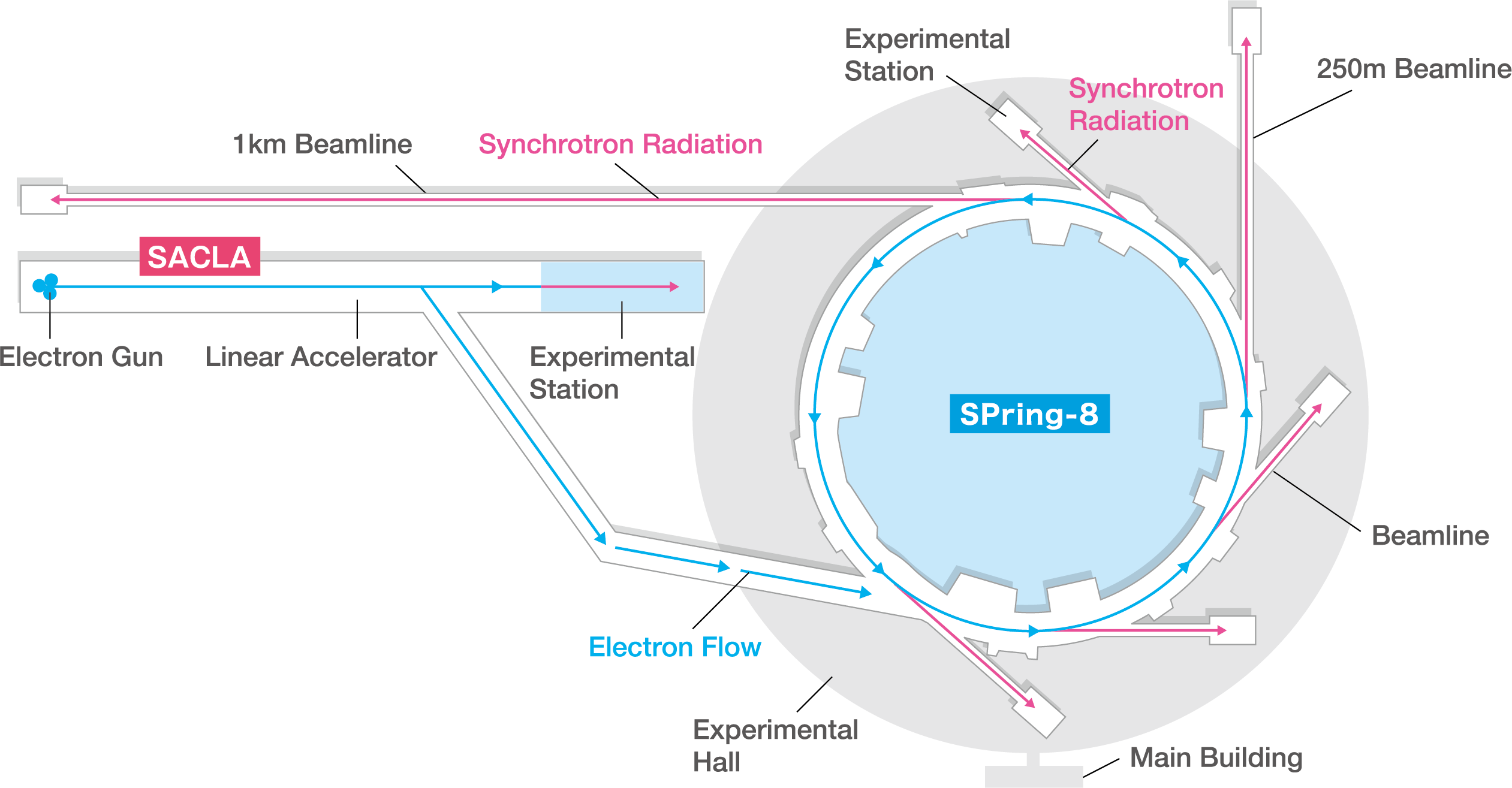
SPring-8 consists of an electron gun to generate electrons, an accelerator to accelerate electrons, and a storage ring to store the electrons for the electron beams. The sequence of operations include: The electrons launched from the SACLA electron gun (1) are then accelerated to 8GeV (8 Billion electron volts) by the accelerator (2),they are then sent to the storage ring (3) which has an outer circumference of approximately 1500m, to circulate, then bending magnets and insertion devices (4) deflect the electrons, generating synchrotron radiation. The generated synchrotron radiation (X-Rays) are guided through the beamline to the experiment hatch (5), which is provided inside and outside the storage ring, and used for various experiments.
-
An electron beam is extracted from a tungsten electrode using an electron gun. The principle is the same as in CRT TVs and X-ray equipment, but a high voltage of approximately 180 kV is used.
-
After accelerating the electron beam to 1 GeV in the 140 m long Linear Accelerator, it is accelerated to 8 GeV in the 396 m circumference racetrack-type Synchrotron and sent to the Storage Ring.
-
The electron beam circulates in the Storage Ring with a circumference of 1,436 m while maintaining an energy of 8 GeV. During this time, synchrotron radiation is emitted by bending magnets and insertion devices (undulators).
-
At the beamline, X-rays of wavelengths suitable for the experimental purpose are extracted from the synchrotron radiation using spectrometers and focusing mirrors, and then irradiated onto the sample in the experimental hatch.
-
Detectors read X-rays emitted after irradiating a sample, changes in the sample itself, and light or electrons secondarily emitted from the sample, and the data is then analyzed.
-
By understanding the structure, properties, and temporal changes of matter in detail, various phenomena from life to the universe are elucidated, leading to the discovery of "theories" and "principles" that govern them.
-
Individual "discoveries" found in various phenomena are integrated and eventually turn into "innovations" that change our lives and civilization. This is essential for the sustainable development of humanity and the Earth, and is what SPring-8/SACLA should always pursue.
What is a beamline?
The beamline is located outside of the storage ring, and is used to lead the synchrotron radiation to the experimental apparatus (station). At the center, a spectrometer shapes the wide spectrum beam to a specific, monochromatic wavelength (energy). Also, interlocks, shutters and high-speed gate valves that block synchrotron radiation are placed along the way to safely work at the station.
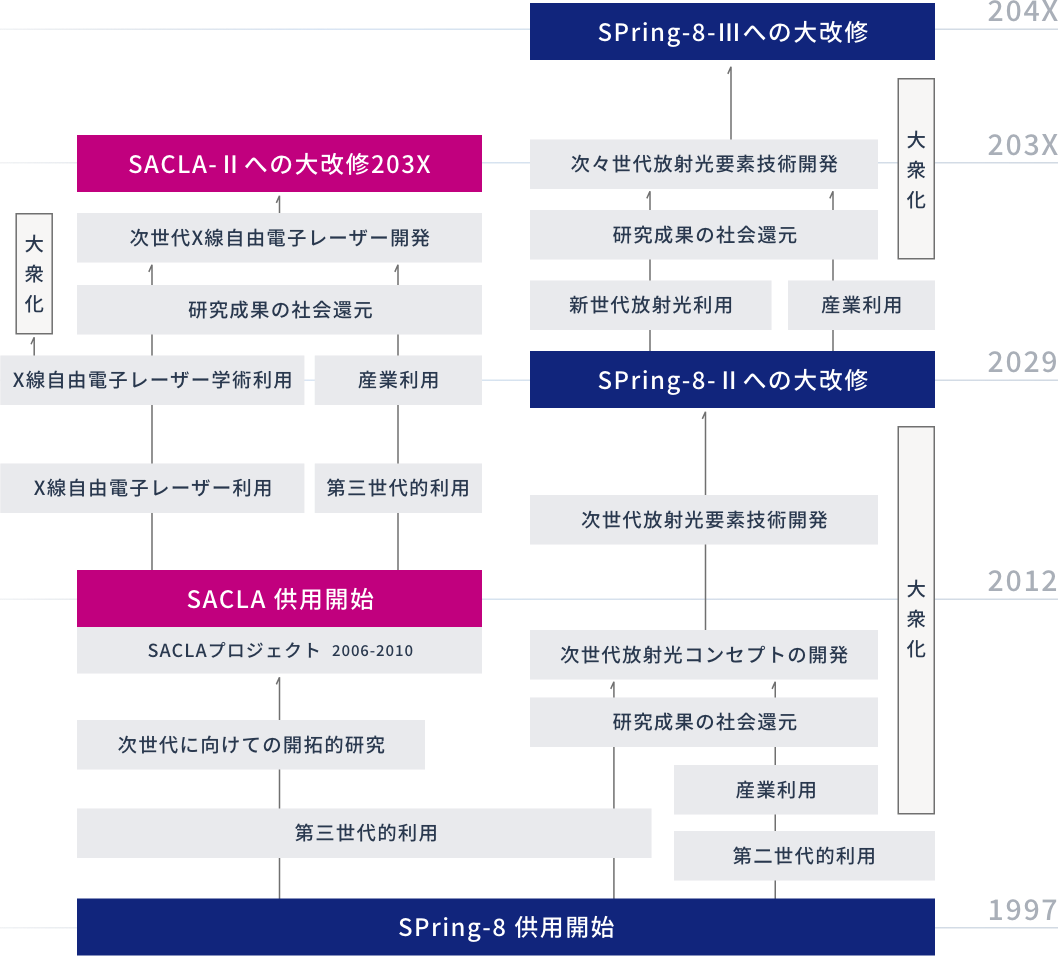
The future of SPring-8
SPring-8 opened for use in 1997, and SACLA in 2012. Almost 20 years after construction, SPring-8 is still considered to be a state-of-the-art facility, and to continue to be a world-class facility, major renovations are inevitable during the 2020s. SACLA will also eventually require major renovations. SPring-8-III is expected 20 years after the major renovation of SPring-8-II, and the goal is to accomplish a ring-type X-ray Free Electron Laser facility at that time.